
Devices keep us connected. But can we connect to the communities whose lives are upended in making those devices? A group of artists and activists show us how.
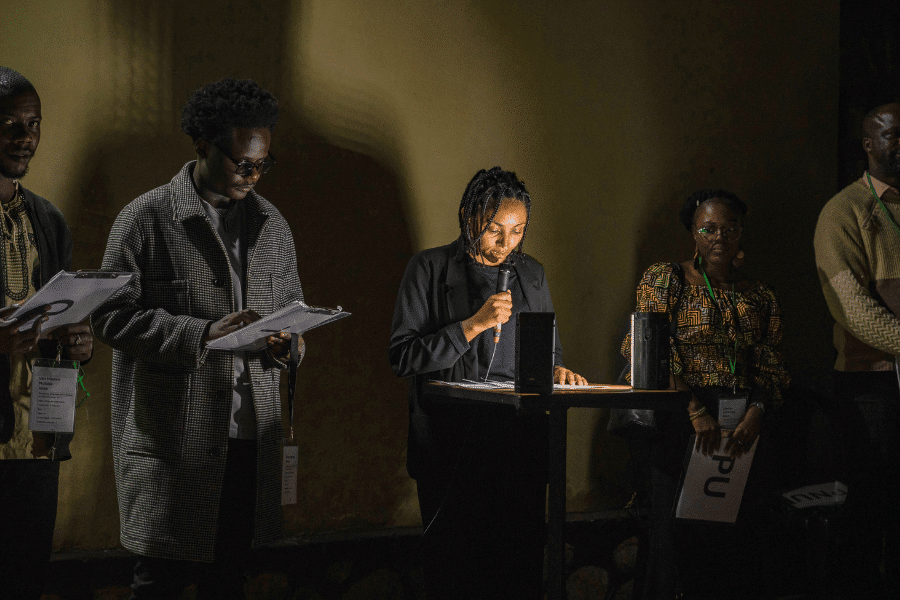
Participants in a social experiment session in Lubumbashi, DRC that was put together by Collectif Cobalt, a collective of artists and activists in June 2025. Run in collaboration with Ukamili, a local enrepreneurs’ network. (Photo credit: Bernadette Vivuya)
Everything is connected. The phone you use to scan a photo, the drive you took across town, that hip or tooth implant that keeps you or a loved one healthy — they all rely on a mineral called cobalt.
And that mineral connects each of us, whether we know it or not, to the people who live in the Democratic Republic of the Congo (DRC), a country in Central Africa.
For years, international mining companies have extracted raw cobalt from communities and villages across the DRC and processed it to produce elements used in medical implants, mobile phones, magnets, wind turbines, lithium-ion batteries and a whole host of high-end tech and industrial equipment used across the world. In this technologically-driven world, most of us can’t live without it.
For local residents, the arrival of a mining company and extraction project should mean an influx of money, employment and the chance to set up income generating activities. Often, the reality couldn’t be further from the truth.
To connect the seemingly disparate realities of the Global South, the people who live with the effects of the mining, and the people of the Global North, who benefit from the end products, is the aim of Collectif Cobalt.
Cobalt and communities
Founded by Bernadette Vivuya, a Congolese journalist and filmmaker, Brieuc Debontridder, a filmmaker, author and mediator, Frédéric Lubansu, an artistic director, actor and cultural rights educator and Farah Youssouf, a poet, author and social rights activist, Collectif Cobalt is a multidisciplinary, multicultural collective of people that creates spaces of dialogue and promotes understanding and civic action around the issue of resource extraction and community exploitation in the DRC.
To translate the lived realities of communities affected and displaced by resource exploitation and cobalt mining across the DRC to audiences across the world, Collectif Cobalt created Festival Citoyen Cobalt, or the Cobalt Citizen Festival, a series of events and exhibits that take place across Brussels, the capital of Belgium — a country which colonised and controlled the DRC for 75 years, committing untold atrocities.
The festival includes a participatory social experiment centred around the lived realities of cobalt mining; an immersive conference which takes people to the heart of the DRC; a photography exhibition; slam poetry workshops; pop-up events across Brussels; and a documentary film screening of Vivuya’s “Stop Filming Us But Listen“.
DRC through multiple lenses
The kick-off photography exhibition invites people to explore life from Kinshasa to Lubumbashi and Goma, to connect with the communities affected by cobalt mining across the DRC.
“How do we, as citizens, engage with and connect to the realities of others?” said Debontridder. “From there, we try to see how, together, we can create new forms of reality that are more caring and more inclusive for all.”
The exhibition houses photos by Debontridder and Vivuya, alongside works by Congo-based photographer Lydia Katanga.
It brings audience members straight to mining regions to show how extraction projects affect local communities, and the contrast between the natural and the built environment.

“Regards croisées sur la République Démocratique du Congo” exhibition at La Maison des Cultures in St Gilles, Brussels, 14 September 2026. (Photo credit: Cathal O’Luanaigh)
Mining our perspectives
Visitors are invited to reflect on lived experience but also to question their own position in the world: how they view the world, why they view it that way and how their day-to-day actions — or inaction — impact the world around them.
An introductory synopsis asks: How do we view the DRC? In what ways do the realities experienced by its people concern us? How and why should we report on this? Does our perspective and interpretation shift depending on whether we are in the Congo or in Belgium?
To heighten the experience, visitors are invited to scan QR codes linked to certain photos.
Each brings up a virtual experience, taking the viewer deeper into the picture either through 360° panoramic views, video interviews with the subjects of the photos or footage that follows social impact teams on the ground in mining regions.
Want to know more about how your devices are made? Check out this other News Decoder story.
The aim: to make us stop and reflect on our role in the world and to make issues that seem far away understandable, tangible, relatable and real to people thousands of miles away — people who live in a seemingly disconnected reality.
Through the photos in the exhibition we meet people who face real hardships. But they remind us that hardships can be overcome and, as we meet the communities on the ground, we begin to feel a complex blend of shared strength, pain and hope.
This feeling, this meeting, is a first step in enacting change because in order to be moved to enact change, people first need to understand what’s happening — in all its complexity.
And for that people need firsthand, reliable or trustworthy information. Those living far from where these things are happening need to feel something in order to relate, to care or to act.
Some exhibit photos feature QR codes that when scanned launch a virtual experience, shown in a screenshot here. This video documentary pop-up by Bernadette Vivuya shows Congolese boxer Balzi Bagunda, known as Kibomango, working with children affected by conflict and displacement. Bagunda was killed in January 2025, reportedly by a stray bullet when rebels entered the city of Goma. (Cathal O’Luanaigh)

Communities collaborating
Another part of the festival is Collectif Cobalt’s flagship project, a collaborative experience in which the audience becomes a community affected by mining extraction.
Players from Collectif Cobalt act as different stakeholders — mining company representatives, politicians, local leaders, journalists — and the audience is invited to react to what’s happening, to make decisions, call for change and work together to fight for their own individual or collective rights.
It started as a collaborative theatre piece played to a small audience. It has since travelled to mining towns across Belgium, the European Commission’s Raw Materials Week, mining conventions in South Africa, conferences on the mining supply chain at the OECD, universities and community engagements in the DRC and continues to be rolled out at events across the globe.
“The idea is to go to companies, international forums and institutions, and run this as an activity that opens up a dialogue,” Debontridder said. “Whether about issues of public interest, you know, things like population displacement or relocation projects, which can happen anywhere for a road, for instance; whole neighbourhoods have been relocated here, too. So it touches on that, but also, of course, the question of resources: resource exploitation, interdependence and reliance on foreign resources.”
No single experience is exactly the same; audiences bring their own perspectives, histories, individual personalities and group dynamics to the process. That said, the process is designed to make participants feel like they have something real and tangible to fight for.
Something to fight for
The collective uses real maps of the city or neighbourhood they are working in. By tailoring the proposed projects to where the experience takes place, participants feel they truly have a stake in the process — something to fight for, something to lose and something to gain.
The buildings and landmarks flagged as being ‘in the way’ and marked to be destroyed are ones you know: your house, your neighbours, your school, your community.
“In other words, [the experience centres on] democracy: how we make our voices heard and how we manage the conflicting interests within a group or community,” Debontridder said. “In a way, by extrapolation, what happens here serves as a microcosm of what’s happening in society at large.”
The collective wrap up by sharing their own experience and stories. Parallels are drawn between the collaborative theatre piece people have just taken part in and the lived realities of communities in the DRC.
A series of photographs taken throughout the social experiment are displayed alongside photos taken on the ground in the DRC. The people present in the room can now see their direct experience mirrored in the photos taken across the world. Members of Collectif Cobalt then share their own experiences of living and working alongside mining projects.
Participants hear firsthand what it is like to live in communities affected by cobalt extraction projects, what it’s like to work as a go-between between mining companies and communities facing relocation, what it’s like to cover the stories of those affected by these projects and how storytelling, community involvement in decision-making and collective action can make a difference throughout the process.
Festival Citoyen Cobalt asks individuals to reflect on their role in society as consumers of information, as active or passive participants in society and as potential agents for change. By inviting dialogue, questioning representation and interacting with a range of creative media, Collectif Cobalt invites us all to the table to join the conversation.
Questions to consider:
1. In what ways does cobalt connect us to Central Africa?
2. Should consumers be responsible for how the products they buy are made?
3. Pick up any product that happens to be near you. Do you know where and how it was made?
Cathal O’Luanaigh is News Decoder’s program and communications manager. Cathal is an educator, linguist and creative with a particular interest in international development, global citizenship and their intersection with the arts. He has a background in Geography (BA), Commercial Music Production (Diploma) and Development and Emergency Practice (MA). He is based in Madrid.